

 Danish

Updated: 04 september 2026
Published: 16 September 2019
Guide to KarryKrimp – portable hose crimper for correct crimping of hydraulic hoses
Crimp your hydraulic hose correctly out in the field with the Parker KarryKrimp hose crimper and Parkrimp No-Skive. The result is faster repairs, less downtime and safe assembly to specification. Always remember to choose the correct hose/fittings, and use the right colours on the crimping dies (die set).
Why choose a portable hose crimper?
- Reduce downtime caused by breakdowns and sudden leaks.
- Crimp hoses on the spot – also evenings, weekends and public holidays.
- Consistent quality.
- Fits a wide range of Parker No‑Skive hoses and fittings.
- Light, robust and user-friendly design (KarryKrimp 1 and 2).
What is Parker Parkrimp No‑Skive?
Parker Parkrimp No‑Skive is a system of matching hoses and fittings that requires no skiving of the outer cover (“no-skive”). The system uses colour-coded crimping dies and clear specifications for crimp diameter, so you achieve a safe, repeatable and documentable crimp.
- No‑Skive: No skiving – faster and safer work.
- Colour codes: Every hose size (DN sizes) has matching crimping dies in a specific colour.
- Specifications: Clear dimensions for crimp diameter and die (black/silver).
Frequently asked questions (FAQ)
Can I use KarryKrimp for all hoses? Always use Parker-approved No‑Skive hoses and fittings that match the Parkrimp specifications.
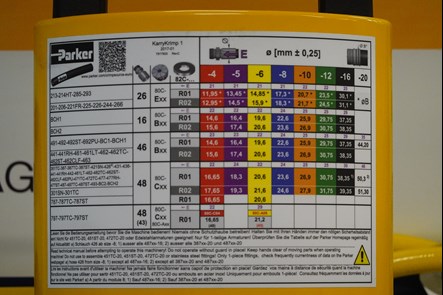
How do I know I have crimped correctly? Measure the crimp diameter and compare it with the Parkrimp table. Check that the insertion mark lines up after crimping.
What if I'm unsure about DN or die colour? Use the chart on the crimper, or contact Hymatik for guidance.
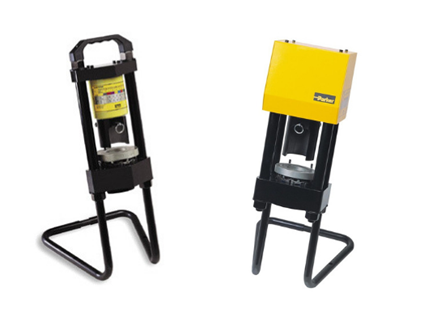
Can I crimp on site without power? KarryKrimp is designed for mobile use. Choose the version and accessories that suit your working environment.
Step‑by‑step: Crimp a new hydraulic hose with KarryKrimp
1. Identify the requirement – including:
- Pressure, temperature, media and environment.
- Dimension (DN), bend radius, length and end fittings.
2. Choose hose and fittings
Select the correct Parker No-Skive hose and the matching fittings. Not sure?
3. Cut the hose to the right length.
Remember to allow for the cutoff factor (the length of the fittings) when calculating the correct length. Use a suitable cutting tool for a clean, square cut. Deburr carefully and keep the ends clean to avoid contamination.
4. Mark the insertion depth
Place the hose alongside the ferrule of the fitting and mark the length of the ferrule on the hose, for example with a coloured marker. Push the hose in until the mark lines up with the edge of the ferrule.
5. Choose crimping die and die ring
Match the DN size with the Parker colour code (e.g. DN6 = red). Also choose the correct die ring (black/silver). The specification chart can be found on the crimper. Now fit the crimping die into the crimper.
6. Position hose and fitting
Insert the assembly into the die. Release the hose and the fitting will move into place by itself.
7. Crimp
Now place the die ring on top of the crimping die. Insert the cylinder and pin, and pump until the die ring meets the base plate.
8. Release the pressure and check
Release the pressure and remove the hose. Measure the crimp diameter and compare it with the Parkrimp table. Carry out a visual check: insertion mark, straight crimp, no damage.
Products and accessories
- Portable Parker KarryKrimp hose crimpers and accessories: See the range
- Parker No‑Skive hydraulic hoses and fittings: See selection


