

 Danish

Updated: 28 August 2026
Published: 23 May 2019
Push-Lok hoses and fittings for low pressure – simple, safe and leak-free assembly
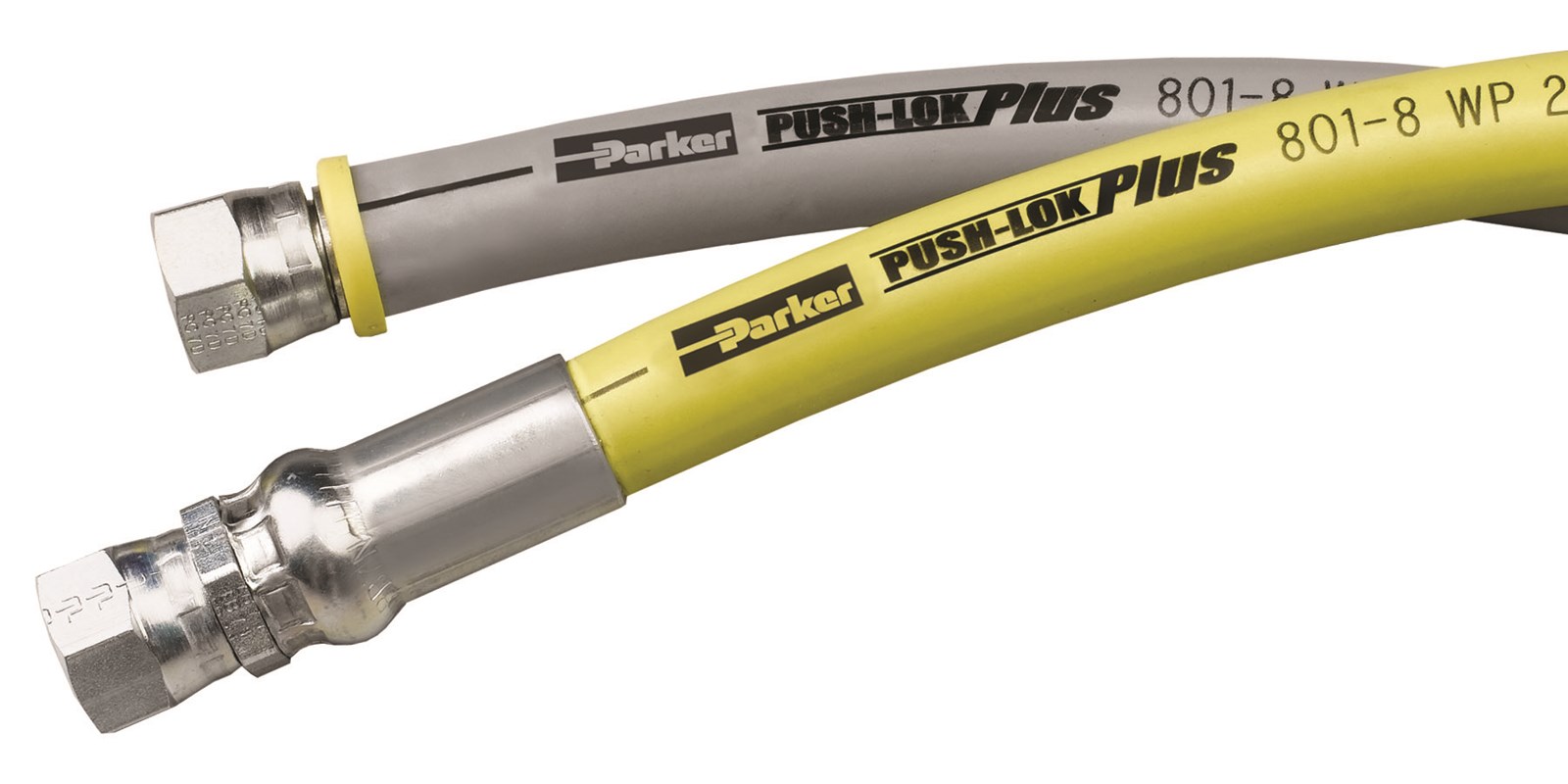
Need a fast and reliable solution for low-pressure applications? Parker Push-Lok is a complete range of hoses and push-on fittings that assemble without clamps and without special tools. Cut the hose at a right angle, push the fitting in as far as the yellow ring and the hose is ready in seconds.
Why choose Push-Lok?
- Assembled without special tools and without hose clamps.
- Leak-free, safe and durable solution at low pressure.
- Wide range: 9 hose types + a large selection of fittings.
- Many media: oil, water, phosphate ester, non-conductive applications and more.
- High flexibility and small bend radii.
- Up to six hose colours for quick identification (size, medium or age).
- Fittings in brass, steel and stainless steel with DIN, BSP, SAE, JIC and ORFS.
Hymatik stocks 801PLUS and 836 in several sizes as well as matching fittings for fast delivery.
What is Push-Lok?
Push-Lok is Parker Hannifin's low-pressure system of hoses and push-on fittings. The system is designed for easy assembly, high operational reliability and flexible use in industrial low-pressure applications.
Typical applications
- Industrial low-pressure circuits and return lines.
- Cooling and lubrication systems.
- Compressed air, vacuum and non-conductive applications (depending on hose type).
- Machine rooms and workshop installations.
How to assemble a Push-Lok hose (step by step)
- Cut the hose at a right angle with a sharp knife.
- Check that the hose end is clean and free of burrs.
- Push the fitting all the way in, until the hose meets the yellow plastic insert ring.
- Pull gently on the hose to check correct engagement.
- Fit into the system – ready for operation.
Tip: Use different hose colours to distinguish media or dimensions in complex installations.
Push-Lok fittings
- One fitting series that fits all 9 Push-Lok hoses.
- Materials: brass, steel and stainless steel.
- End configurations: DIN, BSP, SAE, JIC and ORFS.
- No hose clamps or clip bands required.
See the full fittings range (series 82) at Hymatik
Push-Lok Hoses
The Push-Lok product series consists of 9 different hoses:
6 rubber hoses:
2 thermoplastic hoses:
1 hybrid hose:
- 837PU – For demanding applications incl. the engine industry.
Push-Lok hoses Push-Lok Fittings
Choice of colours and marking
All Push-Lok hoses are available in up to six colours for easy identification.
- Use colour codes per media type (e.g. blue = water, yellow = air, red = oil).
- Mark hoses with date/area for easier maintenance and replacement.
Compatibility and standards
- Connections: DIN, BSP, SAE, JIC and ORFS.
- Media: Oil, water, phosphate ester, compressed air and more (depending on hose type).
- Electrical: Choose 838M for non-conductive requirements.
- Safety: Choose 821FR where flame resistance is required.
Always check the technical data sheet for pressure and temperature limits in your application.
Benefits in operation and maintenance
- Reduced assembly time and fewer errors (no hose clamps).
- Leak-free operation reduces waste and cleaning requirements.
- Colour management simplifies troubleshooting and service.
Frequently asked questions (FAQ)
Can I assemble Push-Lok without tools? Yes. Just cut the hose straight – no special tools or hose clamps.
Which hose for high oil temperatures? Choose 836 or 846.
Which hose is flame resistant? 821FR.
Do you have stock for fast delivery? Yes. Hymatik stocks 801PLUS and 836 in several sizes as well as fittings.
Which hose for non-conductive applications? 838M.
Next steps
- View and buy Push-Lok hoses
- View and buy Push-Lok fittings (series 82)
- Need help choosing? Contact Hymatik by E-mail: ps@hymatik.com tel. 63 12 83 00.


