
 Danish

Updated: 04 september 2026
Published: 30 September 2019
ORFS fittings – leak-free tube and hose connections for hydraulics
ORFS (O-Ring Face Seal) is the industry standard for leak-free hydraulic connections at high pressure and with vibration. With an elastomer o-ring in the sealing face, ORFS creates a reliable seal that can be reassembled and that minimises downtime, spillage and re-tightening.
What is an ORFS fitting, and how does it work?
ORFS (SAE J1453) uses a flat sealing face (“flat face”) with an o-ring that is compressed against a mating face when the fitting is assembled. Unlike metal-to-metal cone solutions, you get:
- A stable seal under pulsating high pressure.
- Resistance to vibration and over-tightening.
- “Zero clearance” – lateral removal/installation without bending/cutting tubes.
- Re-usable seal: the o-ring and flat face allow repeated disassembly/assembly.
Standard and thread types
- Standard: SAE J1453 (ORFS).
- Typical thread: UN/UNF (straight), used with a flat sealing face and o-ring.
- Sizes: typically -4 to -24 (1/4”–1 1/2”) – see product data for details.
Benefits of ORFS for demanding applications
- Leak-free operation: the o-ring compensates for tolerances and vibration.
- Fast servicing: zero clearance makes maintenance easier in tight installations.
- Safety and cleanliness: less oil spillage, a better working environment.
- Low total cost: less re-tightening and fewer stoppages.
Trap-Seal – holds the o-ring in place and prevents assembly errors
Parker’s Trap-Seal technology retains the o-ring in a trapezoidal groove, so that it:
- Does not fall out during storage handling or assembly.
- Is not pinched/cut during assembly.
The result is greater assembly reliability and fewer leaks.
Corrosion resistance with ToughShield
In harsh environments, corrosion is a frequent cause of leaks and seized fittings. Parker O-Lok is supplied with ToughShield plating, documented for up to 1000 hours of corrosion resistance in tests – 10× the SAE requirement. This extends service life and service intervals. Read more about ToughShield here.
Variants and extended temperature/media requirements
- Seal-Lok for CNG: special elastomer with improved ozone resistance and a wide temperature range (-40 °F to 300 °F) for natural gas applications.
- Seal-Lok Xtreme: patented metallic seal for extreme chemistry and temperatures (-328 °F to 1200 °F).
Typical applications
- Mobile and stationary hydraulic systems (construction/civil engineering, agriculture, materials handling).
- Offshore, marine and heavy industry with vibration and corrosive environments.
- Energy and process industry, incl. CNG and other gas applications.
ORFS products at Hymatik
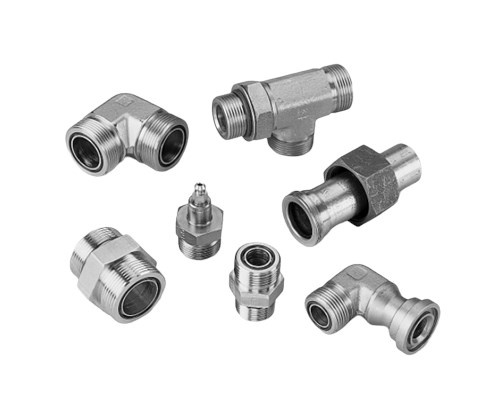
- ORFS tube fittings (Seal-Lok): elbow, tee and straight fittings in many sizes and configurations. Buy ORFS tube fittings.
- ORFS hose fittings: for crimping onto hydraulic hoses for leak-free hose assemblies. Buy ORFS hose fittings.
Why choose Hymatik?
- 100,000+ item numbers in stock and fast delivery.
- A wide range of Parker Seal-Lok ORFS, incl. Trap-Seal and ToughShield.
- If you have any questions, call 63 12 83 00.
Frequently asked questions about ORFS fittings (FAQ)
What is the difference between ORFS and JIC? ORFS uses an o-ring in the sealing face for an elastomer seal, whereas JIC is metal-to-metal (37° cone). ORFS is typically better with vibration and for repeated disassembly/assembly.
Can I reuse ORFS connections? Yes, ORFS can normally be reassembled. Inspect and replace the o-ring in case of wear/damage, and follow the torque chart when assembling.
Which media and temperatures can ORFS handle? Standard ORFS covers typical hydraulic oils and operating temperatures depending on the o-ring material. For extended requirements, Seal-Lok CNG (-40 °F to 300 °F) and Seal-Lok Xtreme (-328 °F to 1200 °F) are available.
How do I avoid leaks during assembly? Ensure cleanliness, the correct o-ring and the right torque, and avoid over-tightening. Trap-Seal reduces the risk of o-ring failure


