

 Danish

Updated: 04 september 2026
Published: 23 May 2019
Guide to storing hoses and fittings
Correct storage matters
Correct storage protects rubber and elastomers against the four main enemies: temperature fluctuations, moisture, UV/ozone and chemical exposure. When the environment is stable, ageing, micro-cracking and leaks are reduced, and you avoid downtime. For companies working with hydraulic hoses and fittings, this means fewer complaints, better safety and lower total costs. Good practice begins the moment goods are received and continues throughout the entire life cycle of your stock, with traceability and systematic inspection.
Best practice for storing hoses
Environment and surroundings – stable, dry and free of UV/ozone
Keep the storage room stable between 15 and 25 °C and below 65 % relative humidity. Avoid direct sunlight and other UV sources; dark bags or boxes help if you cannot shield the shelves. Ozone from certain electrical installations (e.g. discharge lamps) accelerates rubber ageing, so keep hoses away from such sources. Also avoid proximity to heating pipes, compressors and radiators. Hoses should not be stored near corrosive liquids or vapours, and direct contact with oils/grease during storage must be avoided.
Shape, load and storage media
Hoses must be stored in a stress-free shape. Always respect the minimum bend radius – otherwise the reinforcement can be damaged and cause failure later on. Avoid pressure from goods stored above; heavy boxes and reels must not be stacked on top of hoses. Use suitable reels or brackets with a large radius instead of small hooks that create point loads.
Avoid dust and dirt in production and storage
Seal the system before dust finds its way in: fit caps/plugs on both ends as soon as the hose has been produced or received. Store hoses in clean, closed, labelled bags or boxes. Always keep “clean” hoses separate from items that have been in test fluids or in operation, so you avoid cross-contamination that can later damage pumps and valves.
Stock control and rotation (FIFO/FEFO)
Use FIFO for general stock and FEFO for elastomer-sensitive parts, so the oldest or first-expiring items are used first. Batch and lot numbers as well as the date of receipt must be clearly stated on labels. Arrange hoses by dimension and pressure rating to minimise picking errors and unnecessary handling.
Best practice for storing fittings
Fittings are subject to the same environmental requirements as hoses, especially when they contain O-rings or other rubber seals.
Avoid unnecessary repacking, so threads and sealing surfaces are protected against impacts and scratches. Keep types, sizes and thread standards clearly separated in marked boxes, and fit caps on assembly kits to prevent contamination. For fittings with O-rings, a maximum storage time of two years is recommended – here FEFO is particularly important, so you do not install over-aged seals.
Checklist for storing hoses and fittings
- Temperature 15–25 °C and relative humidity ≤65 %.
- No direct sunlight/UV and no ozone sources in the room.
- Caps on all ends and clean, closed storage boxes.
- No sharp bends or pressure on hoses.
- FIFO/FEFO applied consistently, and batch/lot traced.
- Fittings with O-rings stored for max. 2 years.
- Racking and reels dimensioned to the minimum bend radius.
- Monthly inspection documented.

Stock handling for both hoses and fittings
Receipt, labelling and traceability
Start with a visual inspection on receipt: look for transport damage, UV discolouration, flat spots, damaged caps and unusual odours that may indicate exposure to ozone or oil. Record order data, batch/lot and supplier as well as the date of receipt in your system. As a minimum, the labels on the boxes should state product name, dimension, pressure rating, batch/lot, date and shelf location. Clear traceability makes it easy to carry out recalls and quality control should it become necessary.
Safety and ergonomics
Heavy reels and large dimensions require lifting aids to protect employees against overloading. Set up racking at a working height that reduces twisting and overreaching, and ensure sufficient space for safe handling. Good ergonomics reduces errors and increases speed – a significant gain during busy picking periods.
Inspection and maintenance plan
Set a fixed inspection interval so your stock remains stable and safe. Check temperature, humidity and lighting conditions as well as dust and pests monthly. Quarterly, you can carry out spot checks on hoses and look for micro-cracking, flat spots, discolouration and odour. Every six months, you should verify that FIFO/FEFO is being followed, and discard or reclassify old stock. Annually, environmental monitoring is calibrated, racking and safety equipment are reviewed, and labelling standards are updated.
Frequently asked questions - FAQ
How long can hoses be stored?
It depends on the rubber quality, protection and environment. The closer you stay to 15–25 °C, low humidity and no UV/ozone, the longer they last. Always rotate stock using FIFO/FEFO and inspect regularly to catch early signs of ageing.
Can hoses hang on hooks?
Only if the radius of the hook is large enough that the minimum bend radius is not exceeded. Avoid point loads that can deform the hose permanently.
Can hoses be stored in the same room as oil?
We recommend keeping them separate. Avoid both direct contact with and vapours from oils and solvents, which can affect rubber over time.
Why is FEFO important for elastomers?
Elastomers age naturally. With FEFO (first-expired-first-out) you minimise the risk of O-rings and seals exceeding their recommended storage time, which would otherwise increase the risk of leaks after assembly.
Standards for storage and service life management of hoses
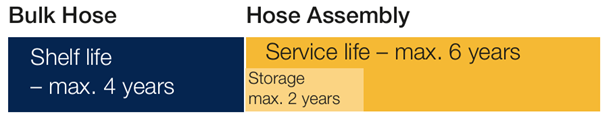
For the storage of hydraulic hoses and hose assemblies in Europe, DIN 20066 is used as the primary reference. The standard sets out guidelines for both the storage and the maximum service life of bulk hose and finished hose assemblies.
According to DIN 20066, the following main principles apply:
-
Bulk hose may be stored for up to 4 years before assembly.
-
Hose assemblies have a total maximum service life of 6 years including storage.
-
The storage period for a finished hose assembly must not exceed 2 years before it is put into service.
The standard emphasises that correct storage (temperature, UV exposure, humidity, ozone, etc.) is crucial, as rubber materials age over time, even when not in operation.
There are, however, several international standards with similar but not identical guidelines, including ISO 8331 as well as ISO 17165-2 / SAE J1273. These may apply different storage periods, inspection requirements and test procedures. In addition, OEM manufacturers may have their own specific requirements.
The choice of applicable standard therefore depends on market, application and customer requirements. It is always the buyer or end user who decides which standard is to be used as the basis for documentation and compliance.
Read more on page Aa-30 (page 68) in Parker's Industrial Hose Catalogue.
Buy hoses and fittings at Hymatik
- See our range of hoses and fittings here
- If you have any questions - tel. 63 12 83 00 or write to ps@hymatik.com


