
 Danish

Updated: 04 september 2026
Published: 27 September 2019
Soft seal vs. metal seal – how to choose the right solution
When working with hydraulic fittings, the type of seal plays a decisive role for both operational reliability and maintenance. For many years, metal seals were the standard, but developments – not least at Parker Hannifin – have led to more efficient solutions using soft seals in the form of gaskets and O-rings.
Soft seals typically provide better tightness, higher tolerance to vibration and pressure impulses, lower tightening torque and the option of easily replacing the sealing element. Metal seals may, however, still be relevant in applications with very extreme temperatures or special media.
What is a soft seal?
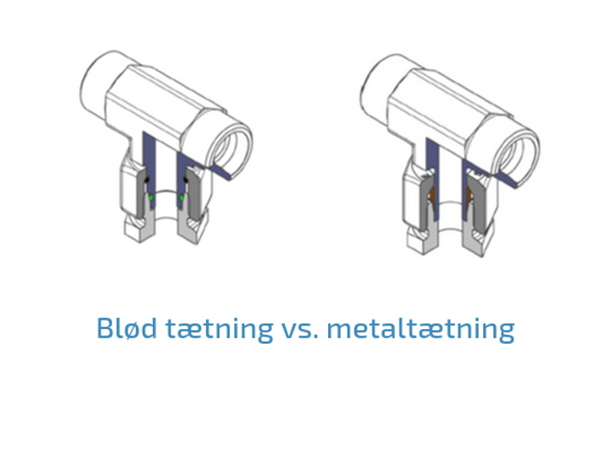
A soft seal is a hydraulic tube or hose connection where the sealing function itself is handled by an elastomer, typically an O-ring or gasket. This achieves tightness without the metal parts having to be deformed in order to close the joint.
The sealing element can also be replaced during service, which makes the solution both practical and cost-effective.
The most commonly used materials are:
- NBR (nitrile rubber) as standard for many hydraulic applications.
- FKM (fluorocarbon rubber) where higher chemical and temperature resistance is required.
The aim is to achieve a robust joint with minimal risk of leakage, even under dynamic operating conditions.
What is a metal seal?
A metal seal relies on metal-to-metal contact, for example via a cutting ring, where tightness is achieved through plastic deformation and compression of the metal parts.
This solution may be necessary in very particular cases, but it is not 100% tight in all scenarios and is generally less tolerant to vibration and pressure impulses compared with a soft seal.
Questions (FAQ)
Is a soft seal 100% tight?
Soft seals typically provide higher tightness in practice, especially under dynamic conditions, as the elastomer compensates for tolerances and micro-movements.
Can I switch from a metal seal to a soft seal without changing the layout?
Often yes. The dimensions are usually identical in the series mentioned. KOR/RED is, however, an exception.
Which material should I choose for the O-ring?
NBR is the standard choice for oil hydraulics, while FKM is chosen for higher temperatures or more aggressive media. If you are in doubt, our technicians are happy to help.
What if my application has strong pressure impulses and vibration?
Here a soft seal is normally the best choice, as it handles dynamic loads better and reduces the risk of leakage.
Benefits of fittings with soft seals
Today, soft seals have replaced many metal seals – and with good reason. The main benefits are:
- High leakage safety, even with pressure impulses and vibration.
- Good protection against the ingress of air and dirt.
- Replaceable gasket or O-ring for easy maintenance.
- Greater tolerance at low tightening torque.
- Independent of the mating part's material.
- Up to approx. 40% lower tightening torque, which means faster assembly.
When should you choose soft seal vs. metal seal?
In the vast majority of applications, soft seal is the best choice if the aim is to minimise leakage, ensure stable operation and make servicing easier.
Metal seals should primarily be considered for very extreme temperatures or highly specialised media, where the properties of elastomer materials may be challenged.
Quick decision guide
- Applications with movement, vibration and pressure impulses → Soft seal.
- Requirements for high availability and short delivery times → Soft seal (global standard).
- Need for easy servicing and replacement → Soft seal.
- Extreme media or temperatures → Metal seal may be necessary.
Choice of material – NBR vs. FKM
The choice of material for the O-ring or seal depends on both the medium and the temperature.
NBR is the standard choice for many hydraulic applications and oil-based media.
FKM is used where higher chemical resistance and temperature tolerance are required.
We always recommend selecting the seal based on the actual operating conditions.
Compatibility and easy replacement
In most series, fittings with soft seal and metal seal share the same dimensions, which makes replacement simple:
- EVL → EL
- EVGE → EGE
- BUZ → VKA
The exception is KOR/RED, which do not have the same dimensions.
Specific product examples (Parker)
DKO swivel fittings with soft seal can, in many applications, replace fittings with a metal cutting ring.
One specific example is Parker EW06LOMDCF (soft seal), which can replace EVW06LOMDCF (metal seal).
You can view the range and stock status directly in our webshop.
Installation and operation
The lower tightening torque required for soft seal makes installation faster and more consistent.
When servicing, you should always:
- Check the condition of the seal.
- Replace worn O-rings or seals.
- Keep threads and seats clean to avoid dirt in the assembly.
Quality, availability and support
Soft seal is today the global standard and offers high availability as well as fast delivery.
At Hymatik we offer:
- More than 7000 item numbers in stock in Odense, and more than 100,000 item numbers at our remote warehouse in Germany.
- Local, national and international delivery.
- Technical support and advice.
📞 Contact us on 63 12 83 00


