

 Danish

Updated: 04 september 2026
Published: 22 May 2019
Prevent future failures in your hydraulic system
Hydraulic systems depend on every component working correctly, and here hydraulic hoses and fittings play an absolutely central role. They work constantly under high pressure and are affected by heat, vibration and wear in the day-to-day operating environment.
When a hose fails, the consequences are quickly felt in the form of downtime, operational disruption and increased costs. Fortunately, many of these problems can be prevented with the right maintenance and attention.
You prevent the most failures by inspecting hoses and fittings regularly, staying within the correct working pressure and temperature, ensuring the right bend radius and hose routing, and documenting and replacing hoses in good time.
Use the checklist below, implement a fixed maintenance plan and take advantage of traceability with Parker Tracking System (PTS) for fast and precise reordering.
Frequently asked questions (FAQ)
How often should I replace hydraulic hoses?
It depends on the environment, operating hours and findings. Replace proactively at any sign of wear.
How do I avoid leaks at fittings?
Correct assembly, correct torque and avoiding twist and vibration.
What is the biggest cause of early hose failure?
Too small a bend radius, thermal overload and vibration.
Does hose protection really help?
Yes, protection against wear and heat increases service life significantly.
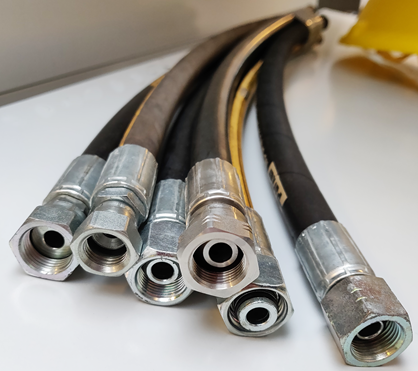
Why are hydraulic hoses
the critical piece?
The hydraulic hose transfers energy between the components of the system and is often the part most exposed to heat, pressure, vibration, the environment and mechanical wear.
A defective hose can lead to downtime, leaks, safety risks and expensive repairs. That is why proactive maintenance is better than reactive replacement.
10-point checklist: Quick inspection of
hose and connections
Carry out a visual inspection when the system is depressurised and cooled down.
- Outer cover: Cracks, scratches, worn rubber or visible reinforcement.
- Fittings: Cracks, corrosion, deformation or loose nuts.
- Leaks: Moisture or oil at the coupling point and along the hose.
- Bend radius: Kinked, flattened or twisted hose (twist = failure).
- Temperature effects: Hard, stiff, soft, blistered or “burnt” rubber.
- Abrasion: Contact with sharp edges or moving parts.
- Pinching or stretching: Lengths too short, incorrect slack.
- Contact with chemicals or UV: Discolouration, swelling or brittleness.
- Clamps and supports: Missing, loose or incorrectly positioned brackets.
- Marking: Is the hose identifiable? Use PTS for traceability.
React immediately to any deviations and plan replacement before failures occur.
Working pressure, temperature and bend radius
Working pressure: Choose hoses with a safe margin above the system's maximum pressure. Pressure spikes accelerate ageing.
Temperature: Stay within the specified medium and ambient temperature. Overheating weakens rubber and reinforcement.
Bend radius: Comply with the minimum bend radius and use elbow fittings where space is tight.
Vibration can be reduced with correct hose routing, hose length and suitable clamps.
Sizing and routing (best practice)
The inner diameter of the hydraulic hose must be sized according to the required flow and pressure drop to avoid unnecessary heat build-up and wear. At the same time, it is important that the hose length is matched to the machine's movements so that it is not stretched at full travel.
Hose routing should be planned with clearance from heat sources and carried out so that twisting and chafing are avoided and the hose can move naturally during operation. To protect the hose further, it is a good idea to use hose protectors, spiral wrap, heat shielding and correctly positioned clamps at suitable intervals.
Correct assembly of hose assemblies
When assembling hose assemblies, it is important that all components are cleaned thoroughly to avoid particle contamination in the system. During installation, twist should be avoided by marking the hose and checking the alignment after tightening.
Assembly components must only be tightened to the recommended level, and after major replacements the system should be flushed to minimise the risk of contamination and operational problems.
Maintenance plan and intervals
A fixed plan ensures stable operation:
- Daily/weekly: Visual inspection using the checklist.
- Quarterly: Extended inspection of clamps, hose routing and heat shielding.
- Annually: Review of critical hoses in high-load areas.
Record inspections, replacements and PTS IDs for a better overview and planned maintenance.
See our large range of hydraulic hoses here
Faster service with Parker Tracking System (PTS)
When you buy hoses from Hymatik, they come with unique PTS tagging, which gives you:
- 1:1 identification of the hose (type, length and fittings).
- Easier reordering without errors.
- Better documentation in your maintenance log.
Learn more about PTS here.
Contact us for urgent hose jobs or visit our shop and workshop at Hvidkærvej 27A, 5250 Odense SV, for fast production of new hoses.


