
 Danish

Updated: 04 september 2026
Published: 22 April 2020
How to measure a hydraulic hose correctly
A correctly measured and crimped hydraulic hose ensures a tight seal, operational reliability and maximum service life. The wrong length can cause unnecessary tension, twisting, too tight a bend or contact with heat and edges, which shortens the hose's service life and increases the risk of breakdown.
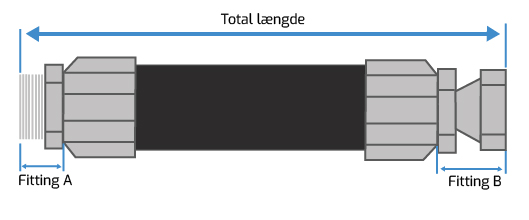
Overall length (OAL) is measured from reference point to reference point on the fittings. Cut length = Overall length – (Fitting A + Fitting B). Add 5 % for pressure effects/movement and respect the bend radius and tolerances.
Why accurate measurement matters
When you know the correct hose length, you avoid making the hose shorter or longer than the original, and thereby avoid it not achieving optimal service life in the application. Especially in hydraulic applications with limited space, it is important that the hose fits precisely, so that it does not end up under tension, kink or be exposed to unnecessary load.
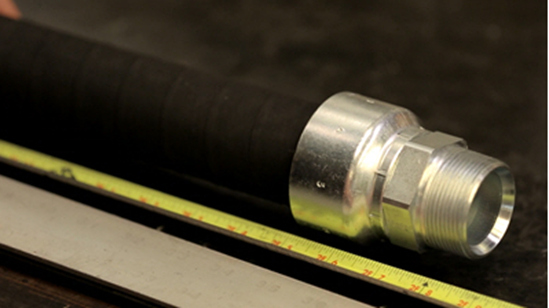
What you need
You get a long way with simple measuring tools and a little knowledge of fitting types:
- Calipers or a good-quality tape measure.
- Angle gauge (for 45°/90° fittings).
- Manufacturer data or length allowances for the specific fittings.
- Knowledge of hose type, pressure rating and minimum bend radius.
Key concepts
When talking about the length of a hydraulic hose, the length can typically be identified in two ways:
Overall length (OAL) is the total length from the measuring reference on fitting A to the measuring reference on fitting B – including fittings. This is the most commonly used measurement when ordering a hose that is to be crimped.
Cut length is the length of the hose before crimping. Use this if you crimp the hose yourself and need to know where to cut it.
Bend radius (min.) is the smallest permissible bend radius of the hose, which must be respected in order to avoid damage.
Change in length under pressure: The hose can become both longer and shorter under pressure (typically 2–4 %). A good rule of thumb is therefore to plan with approx. 5 % extra.
Contact us
- See our range of hydraulic hoses and fittings.
- Use the calculation example as a template for correct measurement.
- Contact us for advice on hose length, bend radius and choice of fittings.
Call us on +45 63 12 83 00, and one of our skilled staff will be ready to help you.
We deliver internationally • Over 100.000 part numbers in stock
See our range of hydraulic hoses here
FAQ
How much does the hose length change under pressure?
Typically 2–4 %. Allow for approx. 5 % extra in the overall length in dynamic systems.
What if I just need to reorder an existing hose?
Measure the overall length using the same reference points as above. Also note hose type, dimension, pressure rating and fittings.
Can I measure in inches and order in mm (or vice versa)?
Yes. Use a reliable conversion (1" = 25,4 mm) and be consistent with units for measurements and tolerances.
Do you crimp hoses for me as well?
Yes. We help with advice and crimping.
Step by step: Measure the overall length correctly
- Identify the fitting types at both ends (e.g. JIC, BSP, metric, ORFS, flange, straight/45°/90°).
- Find the correct measuring reference for each fitting (see the overview below).
- Measure from the reference point on fitting A to the reference point on fitting B in the direction in which the hose is to be installed.
- Take installation space, bend radius and any movement in the application into account.
As a rule of thumb, add 5 % to the overall length in dynamic systems.
Cut length: Calculation and example
The cut length is the length the hose must be cut to in order to achieve the correct overall length after crimping.
Formula:
Cut length = Overall length – (Fitting A + Fitting B)
Example:
Desired: Overall length (OAL) = 1,200 mm
Fitting A length allowance = 28 mm
Fitting B length allowance = 35 mm
Cut length = 1,200 – (28 + 35) = 1,137 mm
If the hose operates under pulsation/pressure and the mounting conditions are not 100 % fixed, a little extra slack can be an advantage, so the hose is not under tension at full pressure or during movement.

All male thread fittings must be measured to the end of the fitting.
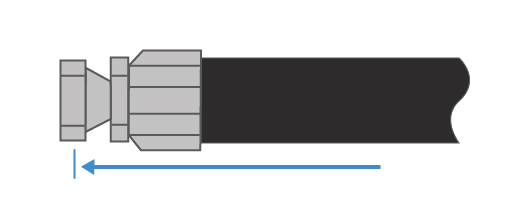
All JIC fittings must be measured to the end of the nut.
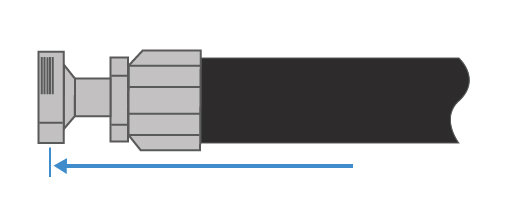
All metric, BSP and ORFS fittings must be measured to the edge of the sealing face.
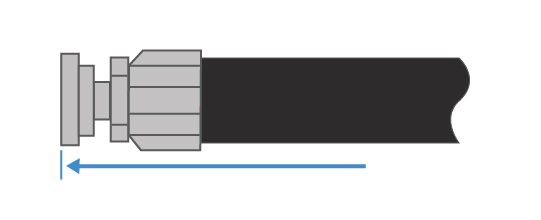
All fittings with a straight flange must be measured to the end of the edge.
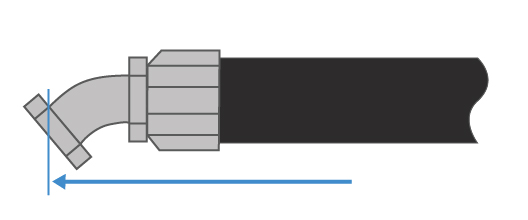
All fittings and flanges with a 45º angle and a swivel nut must be measured to the centre of the sealing face.
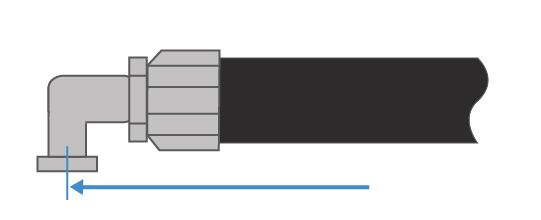
All fittings and flanges with a 90º angle must be measured to the centre of the elbow.
Other factors
Whether you measure overall length or cut length, remember that hoses change length under pressure. Typically the length changes by 2–4 %, which is why it makes good sense to plan with a margin of around 5 %.
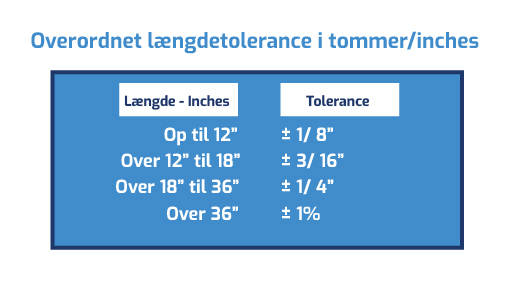
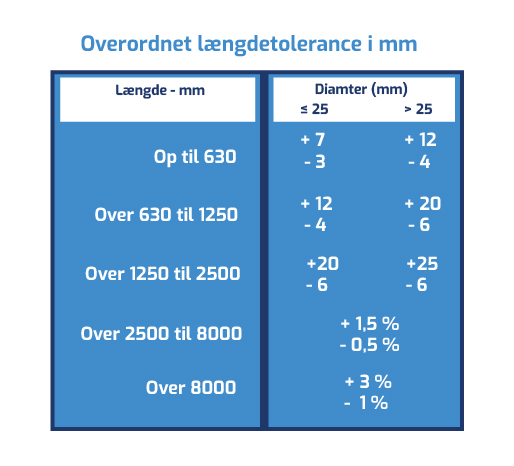
In addition, it can be difficult to measure right down to the last millimetre, and that is why the industry works with length tolerances. (Here you may want to insert your table of tolerances in inches and mm, as mentioned in the original.)
Five typical mistakes, and how to avoid them
- Forgetting the bend radius: Respect the minimum bend radius stated in the data sheet.
- Hose too short: Add slack and approx. 5 % for pressure/length change.
- Wrong measuring reference: Use the correct reference for each fitting type.
- Twist during installation: Orient angled fittings correctly and use clamps/clips.
- Heat/abrasion: Keep clear of heat and sharp edges and use abrasion protection where needed.