

 Danish

Published: May 5, 2026
Identify thread type and sealing method
The thread type and sealing method are crucial for ensuring that your components can be assembled at all and that they remain leak-tight once connected.
If you are unsure how to identify thread type and sealing method, we have created a detailed guide to help you identify both for the most commonly used standards – Metric, BSP (BSPT/BSPP), NPT/NPTF, and UN/UNF/SAE.
Many thread types look similar, and the differences can be difficult to see with the naked eye, but as mentioned, they are critical.
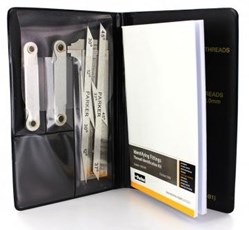
Our thread identification kit includes a range of tools to identify the different elements required to determine both thread type and sealing method. You can purchase the thread identification kit here.
Thread identification
1. Is it a male thread or a female thread?
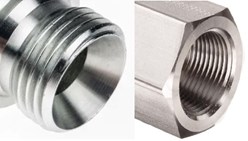
Identify whether it is a male thread (external thread) or a female thread (internal thread).
2. Is the thread parallel or tapered?
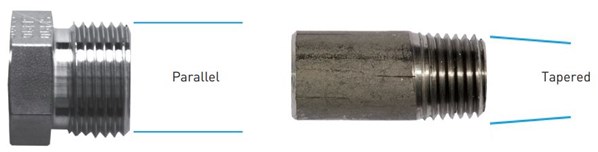
Often, a visual inspection will be enough to determine whether a thread is parallel or tapered. A parallel thread has the same diameter from the first to the last thread, whereas a tapered thread will have a larger diameter at one end than the other. If a visual inspection is not sufficient to determine whether the thread is parallel or tapered, you can measure it using a caliper. Take three measurements on the thread (at each end and in the middle). If all three measurements show the same diameter, the thread is parallel. If the three measurements show different sizes, the thread is tapered.
A quick rule of thumb is that if the fitting has an O-ring, it is most often a parallel thread.
Once you have identified whether the thread is parallel or tapered, you also have an indication of the thread type.
NPT/NPTF, BSPT, and metric tapered are all examples of tapered threads. UN/UNF, BSPP, and metric parallel are all examples of parallel threads.
3. Identify the thread pitch.
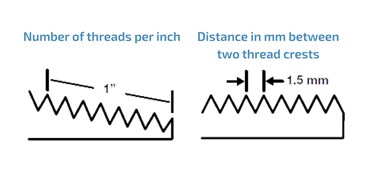
The thread pitch is specified in two different ways. For inch threads, the pitch is defined by the number of thread peaks per inch (TPI). For metric threads, the pitch is defined by the distance between the thread peaks (measured in mm).
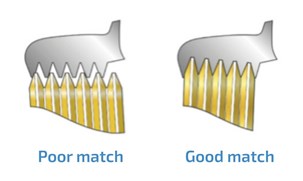
The most reliable way to determine the thread pitch is to use a special tool. This tool is included in the thread identification kit here. When using the tool, try measuring with different pitch sizes, as it can be difficult to determine which one fits best.
4. Measure the thread diameter.
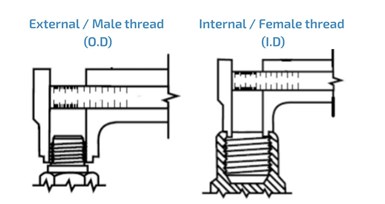
Use a caliper to measure the thread diameter. For a male/external thread, this is the outer diameter (O.D. – Outer Diameter). For a female/internal thread, it is the inner diameter (I.D. – Inner Diameter). If the thread is parallel, the diameter can be measured anywhere along the thread. For a tapered thread, the diameter should be measured at the 4th–5th thread peak.
5. Identify the thread standard.
You have now gathered a range of information that can help you identify the thread.
Be aware that NPT and BSP look very similar and can be difficult to distinguish. In such cases, it can help to know whether the manufacturer of the application/fitting is American or European. NPT is an American standard, whereas BSP is a British/European standard.
Read a more detailed description of the different thread types/standards here (In danish).
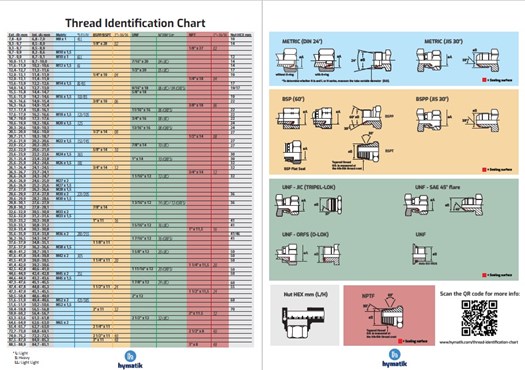
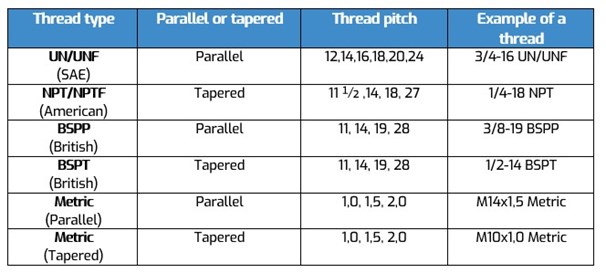
Reference charts for identifying thread types:
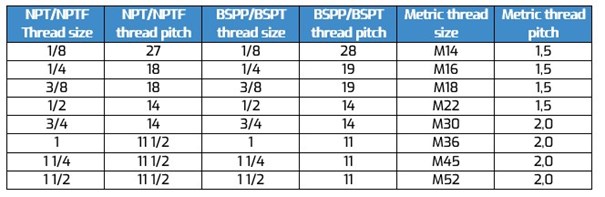
Useful abbreviations for thread standards
- BSPP – British Standard Pipe Parallel
- BSPT – British Standard Pipe Tapered
- DIN – Deutsche Industrial Norme
- ISO – International Standards Organization
- JIC – Joint Industrial Council
- JIS – Japanese Industrial Standard
- NPTF – National Pipe Tapered Fuel
- NPTM – National Pipe Straight Mechanical
- ORB – O-Ring Boss
Typical international thread types and sealing methods:
- BSPP
- BSPT
- Flat Face Port with BSPP (ISO 1179-1)
- Flat Face Port with Metric (ISO 9974-1)
- JIS 300 Flare
- JIS Metric 30° Flare (Komatsu)
- Metric 60° Cone
- Metric Tube Compression (DIN 2353 24° Cone)
Typical American thread types and sealing methods:
- JIC 37° Flare (SAE J514)
- NPSM
- NPTF
- O-Ring Face Seal (SAE J1453)
- O-Ring Pilot Threads
- SAE 45° Flare (SAE J512)
- SAE Inverted Flare (SAE J512)
- SAE Straight Thread O-Ring (O-Ring Boss)


