

 Danish

Updated: 04 september 2026
Published: 23 May 2019
Guide to correct and safe routing of hydraulic hoses
Correct routing of hydraulic hoses is essential for safety, operational reliability and long service life. This guide brings together best practice for assembly, routing, protection and maintenance. The recommendations follow common industry standards and manufacturer data. Always remember to use component and crimping instructions from the same manufacturer.
Correct hose length – avoid tension and overloading
Hydraulic hoses change length under pressure: as a rule of thumb, they can extend by approximately 2 % and contract by approximately 4 %. Always plan a length that allows for vibration, movement and thermal expansion without putting the hose under constant tension. A hose that is too short may pull free of its fitting or overload the seals. A hose that is too long may sag, rub against components or become caught in moving parts.
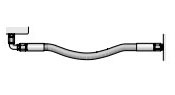
Bend radius – how to avoid kinks and failure
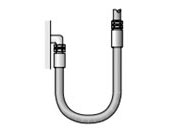
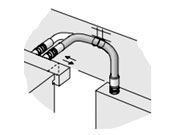
All hoses have a minimum bend radius (MBR) that must never be exceeded. A simple way to check is to shape the hose into a U and measure the distance between the ends; compare this with the manufacturer's data sheet for the specific series and size. Keep the hose straight for at least twice the hose's outside diameter before the first bend at a fitting. If the hose routing requires a sharp change of direction close to the port, choose a 45° or 90° elbow fitting instead of forcing the hose into a tight, sharp bend. This reduces both the risk of internal damage and unnecessary pressure loss.
Avoid twisting (torsion) – use the lay line as your guide
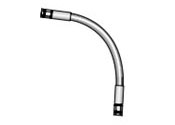
Twisting during assembly damages the reinforcement and can drastically reduce pressure capability. Use the hose lay line as a visual indicator: it must not spiral around the hose after assembly. If you discover twisting, loosen using two wrenches, hold the hose in the correct orientation and retighten. This is particularly important in applications where the hose moves during operation – twisting combined with bending is a frequent cause of premature failure.
Wear and protection – when the environment works against you
Position hoses with clearance from sharp edges, rough surfaces and areas of frequent contact. Where contact cannot be avoided, choose hoses with a reinforced outer cover. Parker hydraulic hoses designated TC (tough cover) or ST (super tough) are hoses with a more robust outer cover offering better abrasion resistance. These hoses are 80 times and 450 times better in abrasion resistance respectively than the standard hose. At Hymatik we stock the tough cover hydraulic hoses in 1, 2, 4 and 6 layers / up to 2” for 420 bar.
Another option is to fit protection such as spiral wrap, sleeves or guards. This prevents wear-through of the cover and significantly extends service life.
See our range of hose protection here.
Ordering and support
- See our wide range of hoses and fittings in our webshop
- If you need advice, you are always welcome to call us on 63 12 83 00
Plan around the machine's movement pattern
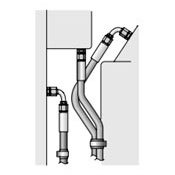
Route hoses so they follow the geometry of the machine. This gives shorter lengths, fewer sharp bends and less risk of tension at the ends. Use elbow fittings to control flow direction and avoid turbulence. Think about servicing: position tube/hose supports and fittings so that inspection and replacement can be carried out without dismantling the entire system.
Use matching components only – crimp to specification
Never mix hose and fitting brands. Always crimp according to the manufacturer's tables using their approved crimp dies and dimensions. Document batch numbers, crimp parameters and dimensions for traceability. Mixing components and deviating from crimping instructions is a frequent cause of leaks and fittings blowing off.
Mounting and support – stability without pinching
Correct mounting reduces vibration and chafing. Use correctly sized tube/hose clamps with rubber inserts, and secure them to static structures. Avoid pinching the hose where it needs to move, and avoid running high- and low-pressure hoses across each other in the same tube/hose clamps, as this increases wear. Let the hose form controlled loops instead of kinks at the ends, and maintain consistent clearances to neighbouring components.
Temperature, UV and chemicals – shielding against the hidden killers
High ambient temperatures and radiant heat shorten hose service life and can cause cracks in the cover. Shield hoses from exhausts, engine blocks, furnaces and other heat sources, or use heat shields and heat-resistant sleeves. In colder environments, the material selection must match the temperature range to avoid stiffness and micro-cracking. Where UV exposure and chemicals are involved: choose a cover and inner core that are compatible with both the medium and any cleaning agents – always check the datasheet for material tolerances.
Inspection and maintenance – simple habits, big impact
Establish fixed intervals for visual checks (e.g. monthly or every 250 operating hours) and schedule function and leak testing quarterly, especially in harsh environments. Look for cracks, blisters, seepage at fittings, rust, wear marks, flat spots and discolouration from heat or chemicals. Check that tube/hose clamps are correctly positioned and that hoses have not started chafing against new contact points. Always shut down and relieve pressure before starting work. Use cardboard for leak detection, never your hands – high-pressure injection is life-threatening. Replace damaged hoses immediately.
Frequently asked questions - FAQ
What is the correct bend radius for my hose?
Check the manufacturer's datasheet for the minimum bend radius for the specific series and size. Never exceed that value during installation or operation.
How much extra length should I allow for?
Size for approximately +2 % elongation and −4 % contraction under pressure, and add allowance for movement and vibration so the hose is never at full stretch.
Can I mix hoses and fittings from different brands?
No. Always use hoses, fittings and crimping tools from the same manufacturer and follow their instructions.


